The Concept of 'Free Miles'
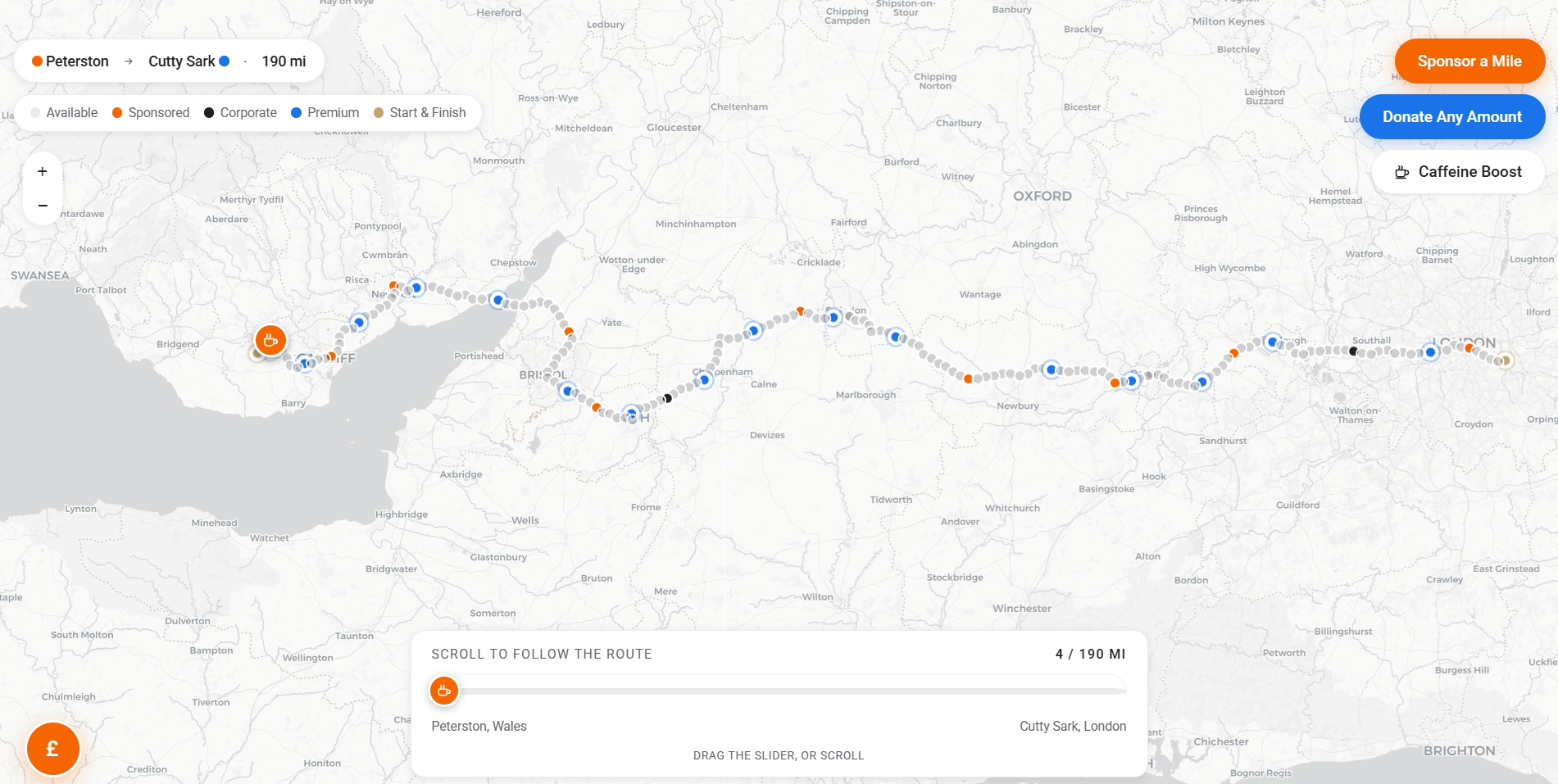
Before looking at pacing or nutrition, I have to acknowledge the staggering level of support I've already received. In ultra-running, we call these 'free miles'. Every donation to Alzheimer's Research UK, every message from a colleague in the tea trade, acts as a literal emotional tailwind that makes the physical burden feel fractionally lighter.
The Physical Architecture
Track the training.
Every run on the road to the start line — stats refresh from my Strava feed.
The physical preparation for an event of this magnitude is entirely rooted in periodisation. You cannot sustain peak mileage year-round without inevitably injuring yourself. My training block is structured into very deliberate phases, starting with a massive foundational base-building period. This isn't about speed; it is about teaching the skeletal and muscular systems to withstand prolonged impact.
The core of ultra-training isn't the single long run on a Sunday. It is the back-to-back long runs. Going out for 25 miles on a Saturday, only to wake up on Sunday with legs feeling like lead, and forcing out another 20 miles. That is where the adaptation happens. It forces the body to operate efficiently when it is already severely depleted.
Fitting this around my life is the real puzzle. I am a tea buyer and blender for a global brand. That means managing time zones, coordinating supply chains, and spending my days tasting. I am also a husband and a father to three young children. My training simply cannot consume the hours they need from me. The result? A significant portion of my mileage happens in the dark. I am running at 4:00 AM before the house wakes up, or at 10:00 PM when the email traffic finally slows down. It is exhausting, but it is the only mathematical way to fit the volume into a 24-hour day.
The Mental Blueprint
If physical training gets you to the starting line, mental training gets you to the finish. I know with absolute certainty that there will be a point—likely somewhere around mile 120, running through the dead of night—where my body will initiate a full-system revolt. It will scream at me to stop. The pain cave is a very real place, and you have to know exactly how you are going to navigate it before you arrive there.
My primary strategy is compartmentalisation. If you stand on the start line in Wales and think about the 190 miles separating you from London, the sheer scale of the task will crush you psychologically. You have to shrink the world. I don't run 190 miles; I run to the next aid station. I run to the next tree. Sometimes, in the darkest hours, I will just bargain with myself to keep moving for the next ten minutes.
I am also deliberately integrating sleep deprivation into my training. By forcing myself out for long, punishing runs after a gruelling day in the tea room and a chaotic evening with the children, I am simulating the cognitive fatigue I will face on the second night of the actual event. You have to learn how to keep putting one foot in front of the other when your brain is begging for sleep.
Fuelling the Engine
Nutrition in ultra-running is often referred to as an eating contest with a bit of running thrown in. Over 190 miles, I will be burning tens of thousands of calories. Traditional sports gels and sugary blocks are fine for a marathon, but over 48 hours, they will destroy your stomach.
My strategy is heavily reliant on training my gut to process real, solid food while in motion. I am currently testing everything from boiled potatoes and salt to precise carbohydrate liquid mixes. The logistical challenge is ensuring that my support crew knows exactly what my stomach can handle at mile 50 versus what it will reject at mile 150. If the nutrition fails, the legs stop moving. It is that simple.
The Unseen Tailwind
Finally, there is the element of this journey that I cannot train for, but which provides the greatest strength: the community. The outpouring of love, the generous donations to Alzheimer's Research UK, and the backing from the UKTTBS have been nothing short of staggering.
When you are out on a desolate road at 3:00 AM, battling freezing rain and questioning your own sanity, the knowledge that people have invested their hard-earned money and their belief in you acts as a physical force. Those messages of support are the 'free miles'. They validate the suffering. They remind me that this is so much bigger than a personal challenge; it is a collective fight for a cure and a tribute to a trade I love.
The architecture is set. The blueprint is drawn. Now, there is nothing left to do but execute the plan, one mile at a time.